Down River Resources | Your Elementary Math Guide: Math Routines
Showing posts with label Math Routines. Show all posts
Discourse is the mathematical communication that occurs in a classroom. Utilizing discourse in the math classroom can be challenging. You may already be thinking: How can I get my students to explain their thinking? Effective discourse happens when students articulate their own ideas and seriously consider their peers’ mathematical perspectives as a way to construct mathematical understandings.

Encouraging students to construct their own mathematical understanding through discourse is an effective way to teach mathematics, especially since the role of the teacher has transformed from being a transmitter of knowledge to one who presents worthwhile and engaging mathematical tasks.

We can find ways to encourage eager mathematicians to share their ideas and to engage with others about their ideas by following three research-based recommendations:

  1. Clarify mathematicians’ ideas in a variety of ways.
  2. Emphasize reasoning.
  3. Encourage mathematician-to-mathematician dialogue. 

The Best Three Ways to Encourage Effective Discourse in Math

The Best 3 Ways to Encourage Effective Discourse in Math

Think about all of the interactions among all the participants that occur throughout a math lesson--in the whole-class setting, in small groups, between pairs of children, and with the teacher. We will dive in deep today to learn the BEST three ways to encourage effective math discourse in your classroom.

Students working together in math as they use discourse.Clarify mathematicians’ ideas in a variety of ways.

Clarification is important for English learners because it reinforces language and enhances comprehension. We often think of using this skill in reading, but it’s equally important in mathematics!


Here’s some practical ways to use clarification in the classroom: 
  • Restate ideas as questions to verify what mathematicians did. This allow also them to confirm what you’ve heard or observed. 
  • Apply precise language and make significant ideas more apparent.
  • Look for opportunities to clarify questions to ensure that ALL students understand ideas and reasoning.
  • Ask others to restate someone else’s ideas in their own words. This expresses ideas in a variety of ways and encourages listening to one another.
  • Use teacher prompting. (See examples in the photo below.)

When we pay attention to mathematicians’ ideas, we send a message that their ideas are valued. This is the key to encouraging participation of individual mathematicians.


Clarifying Math Ideas : Encourage Effective Discourse in Math

Emphasize reasoning.

Getting mathematicians to explain their reasoning is hard at first! Reasoning helps mathematicians understand their own thinking and the thinking of others. As they communicate about ideas, mathematicians will make connections between relational understanding and move towards mathematical proficiency.


Here’s some practical ways to use reasoning in the classroom: 
  • Ask follow-up questions whether answers are correct or incorrect to place an emphasis on the reasoning process. This is to help mathematicians understand the others’ thinking.
  • Follow-up on both correct and incorrect answers to reduce anxiety. We do not want students only having to explain wrong answers!
  • Move mathematicians to more conceptually based explanations when able. 
  • Ask mathematicians what they think of the idea proposed by another.
  • Ask mathematicians if they see connections between two of their ideas OR an idea and a concept previously discussed.
  • Use teacher prompting. (See examples in the photo below.)

Explain Math Reasoning: Encourage Effective Discourse in Math

Encourage mathematician-to-mathematician dialogue.

We wants eager mathematicians to think of themselves as capable of making sense of math. We do not want them to rely on teacher as the keeper of all knowledge. Encouraging student-to-student dialogue can help build this positive sense of self.


Here’s some practical ways to use student dialogue in the classroom:

  • When mathematicians have different solutions, ask them to discuss one another’s solutions.
  • Ask someone to rephrase another mathematician’s ideas or add something further to someone else’s ideas.
  • Before a whole class discussion, have mathematicians practice their explanations with a peer. {This supports ALL mathematicians.}
  • Use teacher prompting. (See examples in the photo below.)

Mathematicians are more likely to question one another’s ideas than the teacher’s ideas.


Encourage Student-to-Student Dialogue: Encourage Effective Discourse in Math


The value of student talk throughout a math lesson cannot be overemphasized. As mathematicians share their approaches, describe and evaluate tasks, and make conjectures, learning will occur in ways that are otherwise unlikely to take place.

Remember, whoever is talking is doing the learning. Will it be you or your mathematicians?

I hope you use the suggestions recommended in any of the three ways to encourage effective discourse in math.

How are you currently using discourse in your classroom? 
What recommendation would you like to add to your repertoire?


Make sure to pin and save this post for future reference.

Students working together using math discourse.

Students that have "number sense" can solve a problem in a variety of ways. Flexibility with numbers is what helps these students show their sensational number sense.

Researchers have linked good number sense with skills observed in students proficient in the following mathematical activities: mental calculation, computational estimation, judging the relative magnitude of numbers, recognizing part-whole relationships and place value concepts; and problem solving.

Most Number Sense routines take an average of about 10 minutes and are incorporated at the beginning of the math block.

There's four common Number Sense routines that are used daily in elementary math classrooms across the world. Okay, friend, here's what you've been waiting for...

Number Sense Routines: Estimation Task, Number Talks, Which One Doesn't Belong, and Other Number Sense Routines. (Notebook with these words written in an organizational chart.)

The Best Number Sense Routines for the Elementary Math Classroom


1. Which One Doesn't Belong? (WODB)


Which One Doesn’t Belong? is a routine that revolves around an thoughtfully designed four image set. Each of the quadrants can be a correct answer to the question “Which one doesn’t belong?”

Because all their answers are right answers, students naturally shift their focus to justifications and arguments based on properties. A teacher can facilitate rich discussions and teach mathematical argumentation using Which One Doesn’t Belong? You can use this routine to listen closely and respectfully to students’ ideas.

Resources for Which One Doesn't Belong?


Guiding Questions: What do you notice? What makes all the items alike? What makes them different? Which one doesn’t belong? Can you share your reasoning to justify your answer?

Image Website: http://wodb.ca/index.html

Twitter Hashtag: #wodb


2. Number Talks


Number talks are brief discussions (5–15 minutes) that focus on student solutions for a single, carefully chosen mental math computation problem or a number string, a series of related problems. Students share their different mental math processes aloud while the teacher records their thinking visually on a chart or board.

Resources for Number Talks


Guiding Questions: How did you solve that? Explain why you did that? How did that help you solve the problem?

Book Recommendations: This is my FAVORITE book for Number Talks (by Sherry Parrish) and is appropriate for all elementary grades.

I really appreciate the myriad of suggest problems to use to help students practice specific strategies. They are all laid out in this book. It's like a huge resource bank for Number Talks. There's also video footage of variety of Number Talks, which helpful for newbies to this routine.

There is another series of book for upper grades that I recommend: Making Number Talks Matter: Developing Mathematical Practices and Deepening Understanding, Grades 3-10. I have found valuable information in this book, but has less examples than the first text I recommended. It is typically less expensive that Sherry's book.

Twitter Hashtag: #numbertalks


3. Estimation Tasks


Estimation is a skill that occurs naturally but one that needs to be nurtured and massaged as the child's brain develops. Think: use or lose it. Estimating a quantity weaves in mental computations that require problem solving and critical thinking.There are a variety of estimation tasks that students can engage in including physical models and virtual models.

The most common estimation task for grades K-2 is an estimation jar. Fill a jar with similar objects (examples: cereal, marbles, mini erasers, etc.). Have students take one scoop out of the jar. Then, ask students to estimate how many scoops it will take to empty the jar. Record students' thinking and responses.

Resource for Estimation Tasks


Website Recommendation

Estimation 180 is best for upper elementary math. Estimation 180 provides students with opportunities to strengthen their number sense and mathematical thinking through the use of engaging visuals and rich discourse. The visuals at Estimation 180 allow students to engage in mathematical conversations where students are encouraged to support their mathematical claims with evidence and reasoning.


4. Other Number Sense Routines


This is a broad category for every other Number Sense routine.

The most popular books for these routines are Number Sense Routines (see below for links).

Resources for Other Number Sense Routines


Book Recommendations: These are two excellent books that help teachers understand the learning trajectories for the number sense routines.

Find the primary book here: Number Sense Routines: Building Numerical Literacy Every Day in Grades K-3.

Find the upper elementary book here: Number Sense Routines: Building Mathematical Understanding Every Day in Grades 3-5,


I hope this list of Number Sense routines and suggested resources gets you thinking about implementing OR diversifying your Number Sense routine in your classroom.

What number sense routines do you currently use in your classroom? 
What routine would you like to add to your repertoire?


Make sure to pin and save this post for future reference.

Pinterest Image: Down River Resources (Notebook picture)

Vroom! Zoom! Have you been hearing about Math Speed Strips lately? Math Speed Strips will quickly become your students’ math activity to use as an early finisher or math center activity. (I love using them in the first couple of minutes of a guided math or small group math lesson!) This post highlights the basics of Math Speed Strips, how to use them in your classroom or home, materials needed, and other commonly asked questions.  There's also a free set of Speed Strips that I want to share with you to use in your classroom or home!

Speed through subitizing and develop number sense with these differentiated sets of Math Speed Strips.

Sometimes the best opportunities come out struggles. It was mid-December and a kindergarten teacher had asked me to model a guided math lesson on the reviewing the numbers zero through 10. My goal was for this small group of kindergarten students to understand the relationship between numbers and quantities. The teacher gave me some background knowledge about the students in the group and shared that the students were ready for numbers six to 10.

Our warm-up to the lesson began. I eagerly asked the students to use their dry erase markers to write the number four on their whiteboard. The students took off the lids to their markers and starred at me. It was like they're little faces were saying, "You want us to do what?!" I immediately knew that my planned lesson was out the window! I KNOW you have been there too! It was in this moment that I realized that I needed to create a quick, fun way to help students read and recognition numbers to build subitizing and number sense skills which is painless for teachers to use in their math classrooms! Introducing Speed Strips...

* Please note: We are a participant in the Amazon Services LLC Associates Program, an affiliate advertising program designed to provide a means for us to earn fees by linking to Amazon.com and affiliated sites, at no extra cost to you. I only recommend items that I use regularly and know you will love!

Simplifying the Road to Number Recognition and Subitizing 


Speed through subitizing and develop number sense with these differentiated sets of Math Speed Strips.
What are Math Speed Strips?


Vroom! Zoom! Energize your students with these simple strips that represent numbers in many different ways. Each set has 26 cards and each card has five numbers represented on them. The objective is that students move left to right along the strips and read the number representations. At first, students will rely on counting each number. As students practice and build their number sense, students will begin to subitize, or instantly recognize the numbers. Students can use Speed Strips independently, with a partner, or in a small group.

If you want to create a routine for using Speed Strips, add a quick two or three minute practice at the start of your small group or guided math lesson. 

Speed through subitizing and develop number sense with these differentiated sets of Math Speed Strips.
How to Use Math Speed Strips

Students get a set of cards, it can be randomly selected or assigned. Students may choose to use a mat to work through the cards in the set. 

Speed through subitizing and develop number sense with these differentiated sets of Math Speed Strips.  If using a mat, the students will place the set of cards in the center of the mat. Each card will be read left to right. Students can use their finger, a pointer, pencil, or toy car to move along the racetrack as the students read the car. These Speed Strips allow all students access to the numbers, by activating their auditory, visual, and kinesthetic modalities. 

Auditory: Students say the number.
Visual: Students see the number represented on the car.
Kinesthetic: Students move a physical object across the card as they read the numbers.

Materials Needed

Scissors or Paper Cutter
Hole Punch (I used my three-hole punch)
Binder Rings

How to Organize


Speed through subitizing and develop number sense with these differentiated sets of Math Speed Strips.  There are a variety of ways to display Speed Strips, if you are interested in something more than tossing them into a basket. I prefer each card set being accessible.

You can place Speed Strips on a peg board.

Speed Strips can be displayed on jewelry displays found at local hobby and craft stores.

Magnetic hooks placed on the side of a filing cabinet work too.

Command Hooks could also be used to place Speed Strips on an already existing surface.

How to Prepare the Sets of Cards


1. Print Speed Strips on colored cardstock. I used a rainbow pattern for the sets of cards. There is a full color cover (optional) or a black and white cover that comes with each set of cards.

- I love the versatility of colors. If you like specific colors or your classroom has a theme, you can print out the sets of cards using those colors. I used six different colors in my pattern, but any would do! 

- If you like using six colors like I did, you would need 9 pages of colored cardstock for each of the 6 sets... so 54 pages of colored cardstock in six different colors. 

- You can make it simple by buying a large pack of colored cardstock and just using them or mix-and-match the colors to your hearts content. I use Recollections by Michaels cardstock. I load up my race cart on scrapbook paper sale days... it is great for printing Speed Strips and math centers.

2. I ALWAYS cut before I laminate, but I realize that most teachers laminate the pages before cutting! I use a Swingline® Paper Trimmer as my go-to paper cutter. I was able to cut 5 pages at a time (since it is heavy cardstock, which sped up the prep time!

3. Place the Speed Strips at the edge of the three-hole punch (see photograph for alignment). I use a Swingline® 20-Sheet Desktop Hole Punch - Silver. Since I was using cardstock, I only punched a few at a time. If you punch too many, the strips get stuck and can easily tear. Avoid this by punching about five strips at a time.

4. Place each Speed Strips set on a binder ring. Each strip is identifiable by a letter of the alphabet on the right side. You can organize the Speed Strips in alphabetically or randomly. Just make sure the cover shows when displaying the cards!

Speed through subitizing and develop number sense with these differentiated sets of Math Speed Strips.


If you want to use this activity to check each students’ level of understanding, there are pre-assessments and progress monitoring tools included. These tools can help you meets students' individual needs for RtI or intervention through these simple assessments (see below at some of the tool included.)

I love using the colored sponge tip applicators when collecting data on the students. It is so simple to mark the correct responses!

Speed through subitizing and develop number sense with these differentiated sets of Math Speed Strips.


Want to try these for FREE?

I'll keep you afloat. I encourage teachers to give them a try, but I can guarantee that once your students start using Math Speed Strips, they will be begging you for more!  Download a free set of Speed Strips by clicking on the button below!


Speed through subitizing and develop number sense with these differentiated sets of Math Speed Strips.

What skills are included in this Speed Strips Number Sense Bundle?


Dice
Dominoes (common representations of the number are shown on the ends of the domino)
Mixed Dominoes (mixed representations of the number are shown on the ends of the domino)
Ten Frames
Tally Marks
Numeral

These skills are represented on six card sets for each of the number sets 0-5, 6-10, 0-10, 11-15, 16-20, and 0-20. 

These groupings of numbers allow students to master small number sets, before adding numbers that are unknown. It helps build on students' strengths!

If you want to use the 36 differentiated Math Speed Strips in your classroom, you find it in my TpT shop. 

What ways are you promote subitizing and number sense in your classroom?


We all know that a more appropriate title for a teacher in December is "Chaos Coordinator!" You are constantly putting forth time and a lot of effort this time of year in so many areas. It is time to embrace your newly earned title in the classroom and engage your students with some winter-themed and Christmas-themed math activities for young children! These math activities will help you embrace the chaos and let your students math skills and creativity shine!

How to Embrace the Chaos with December Math

As we enter the busy season of holidays, it is difficult to keep students engaged in the content. It is often hard for us as teachers to stay focused and on track too! {I am not pointing at myself right now.}

By using the holiday, which is usually the distraction, as a focal point in the classroom, students become highly engaged in the content.

Embrace the chaos and select a math activity that is right on point for your class... here are a few of my favorite things!

From Chaos to Creativity: Top December Math Ideas


Wreath Math Craftivity {4 Skills}

One of the newest craftivities to hit my shop is this gem, Wreath Math Craftivity! Add paper plates and, perhaps, a dot marker with sponge tip applicator!{I make a small commission when you shop using this link which keeps the Diet Coke fund from running dry and the creativity flowing!}This creates a simple craftivity for students to complete. It gets even better than this cute wreath! There are four math skills that you can use as "ornaments" to decorate your wreath. {grades K-2}

- Sequencing Numbers (1-10, 10-20, random numbers up to 120, random numbers up to 1,200)
- 2-D Shapes (two dimensional shapes)
- 3-D Shapes (three-dimensional shapes)
- U.S. Coins 


Christmas Craftivity {Wants and Needs}

Do you teach wants and needs as part of your math or social studies curriculum?

The best way to teach wants and needs is in context. What not a better way than as students are generating a Christmas list?!

Don't worry, as with all of my resources, I strive to make them diverse. This craft includes two versions with Santa or a snowman to be inclusive of ALL students, especially culturally diverse students.

This is a great activity for little hands as the cutting is very simple. I took extra time when I created this to define the lines for cutting for younger students.

Splat! Interactive Math Games

If you have not heard of Splat! math games yet, you are missing out! I wrote about these fun, interactive games a little while back. You can catch up on how to play Splat! here. I have seasonal and skill-based games for winter including these sets:

Gingerbread Themed:

Reindeer Themed:
- Generate a Set to 20 {grades K-1}

Christmas Emergent Readers

Make sight word practice fun, engaging, and interactive with these math emergent readers!

These are perfect for math or literacy centers with a winter or Christmas theme. I love that you can use them for sight word practice, math centers, OR literacy centers! They are so versatile!

Students practice sight words in a math context with skills:
- instantly recognizing numbers (subitizing)
- compare sets of objects, (more/less)
- identify 2-D shapes
- distinguish between wants and needs.

There are so many standards-based winter and Christmas activities to choose from to support your math instruction during December. Embrace the chaos and keep the students engaged this holiday season with purposeful  math activities!

If you would like to use any of these activities in your classroom, you can find them in my TpT shop.

How do you embrace the chaos in your classroom? 

I anticipate the return of the back-to-school nightmares. The dreams about a fresh start back to school that end up in nightmares about not being prepared or things being out of order before the students arrive in their brand-new shoes and bright new uniforms. Can you relate? What back to school nightmares do you have? One thing I do to avoid these nightmares from becoming reality is to plan ahead. One of the first things I like to figure out is how to use the long list of school supplies that will soon take up the entire counter in my small classroom! All of my notebooks, whether spiral or composition, are used as interactive notebooks for the different subject areas, including math. I have most recently streamlined the process I have used for the last few years so that I can set-up notebooks in snap!


Interactive Notebooks are Easy to Setup 


There are some essential pages that you will need when beginning interactive notebooks in your classroom.

These pages are like the "front matter" in a chapter book. The pages, such as the title page and preface, that precede the main text of a book are considered "front matter."

An interactive notebook also has front matter, including a title page, table of contents, and a rubric that precede the content-specific information that will grow throughout the school year.

If you have this front matter ready and photocopied during the first week of school, you can start preparing your notebooks with your students. You can create the front matter yourself using my examples from the photographs or purchase these pages.

Breaking up preparation for each notebook during the first couple of days of school works the best. It is helpful for getting the students back into the groove after they enjoyed their summer off. I try to have a whole class activity, which helps build the community of learners, and then have an independent activity to practice the acceptable voice tone, or voice level. I repeat this pattern for the first week of school and then begin our regularly scheduled days with specific standards-based content.

Read more about building a community of learners and a few of the activities I have used with success here.

Throughout the first few days of school, we work on different components that can be found in all of the interactive notebooks we use for each subject. 

Cover Page 


Create a blackline, or black and white copy, of a notebook cover. Minimally, the cover page of a notebook needs to have a place for the student's name and the subject area. 


If you rotate classrooms or the notebooks go back-and-forth from home to school, you may also want to add a room number where the notebook belongs.

I like to use a blackline copy for the front cover as it encourages students to get creative and personalize their notebooks. This helps build a sense of ownership of their notebook and the items will be collecting in them as the year progresses.

I also like to add a strip of colored duck tape to the spine of the notebook. Each subject is identified by a different color of tape. For example, all of the science notebook spines are green while the math notebook spines are blue. This helps students organize their materials. This is especially helpful for younger students sifting through their desks attempting to locate the correct notebook.

Title Page 

Another way to denote important locating information on a notebook is on the title page. Many teachers like to include a title page as it resembles a reference book that you would access at the library.

When preparing students for the real-world and teaching real-life applications, it is important to expose students to accurate information. Something as simple as a title page, can prepare students for researching topics as they advance in the education.

Several teachers like to use a title page for additional information, including the teacher's name, class period (if applicable), and the school year.

This can also be a place where students can get creative and personalize their notebooks too.

Table of Contents

Locating information in an interactive notebook is made
easy with a table of contents. A simple table that includes the page number and title of the entry is most important. I also like to record the date of the entry too.

A table of contents is one of the places that is most difficult to keep up with so you want to establish a routine. 

When students are directed to get out their interactive notebooks, they immediately open to the table of contents. By creating this routine, students know that the first thing that they are responsible for is recording the entry on their table of contents.

I create an interactive notebook along with the students so I record the entry first and then use a document camera and overhead projector to show the students my entry. This is very helpful for younger students as they will need to copy the words into their notebooks.

Grading Rubric 

A grading rubric is another important element to feature in interactive notebooks as it presents the expectations for the notebook. 

I have two rubrics that I use including one rubric that measures the entire notebook and another rubric for checking individual pages.

When grading a specific page, I give the students the opportunity to present their best work. I let them know in advance that a certain page number will be graded using the rubric. 

I do not grade each notebook daily. I usually spot-check notebooks. One of my favorite ways to do this is during recess. I ask the students to open up their notebooks to the page I want to check right before they leave the classroom. When I return from dropping off the students, I quickly walk around the room and check their entries.

These are the essential components that I use in all of my interactive notebooks. Teaching routines and procedures for getting out their notebooks, recording information on the table of contents, and the expectations for notebook pages take some time at the beginning of the year. Once the routines and procedures are learned and practiced regularly, using interactive notebooks will become much easier. Students will beg you to create an entry in them before you know it!


If you would like to use my interactive notebook starter kit, you can find it in my TpT shop.

What are your secrets to setting up interactive notebooks?


I love using math interactive notebooks! They have been a part of my classroom routine since I moved to Texas. Regardless of the grades I’ve taught, I have found success using them with all of my students in kindergarten, first, second, third, and fourth grades. After all, most of my teaching experience could be summed up by those grade levels! While interactive notebooks can be used in any subject, my favorite subject to use them in is math! Take a look at five of the reasons why you need to check out my math interactive notebooks.

TEKS-aligned math interactive notebooks are perfect for kindergarten, first, and second grades.


Interactive Notebooks in the Mathematics Classroom


1. Math Interactive Notebooks are…well, interactive! 


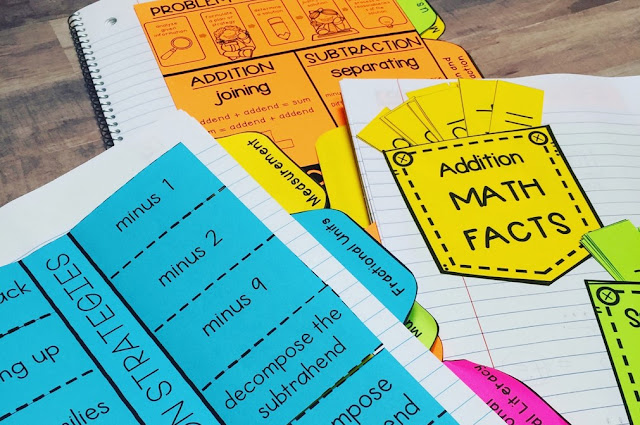
TEKS-aligned math interactive notebooks are perfect for kindergarten, first, and second grades.Interactive notebooks allow students to get hands-on practice or show mastery of a specific concept or skill. Students practice or show their understanding of a topic by “interacting” with it within their notebook.

Interactive notebooks contain folds and flaps, or graphic organizers, that are created to “move” with the students. Students cut, fold, crease, and glue tabs into their notebooks. These specially-shaped pieces become a medium for the students. Students draw, write, generate, create, use, location, model, describe, solve, represent, determine, and a plethora of other actions, using their folds and flaps within the interactive notebooks.

Students are engaged and excited as they learn using their notebooks! 

These notebooks are just not for days when students are adding to it. My students use their notebooks daily as a scaffold and support for their new learning, new and old. I used to get frustrated when my students were constantly asking me how to special something or how exact of a process. Can you relate?

Interactive notebooks work as an anchor for student learning too. Just like a chart on the wall, students access the information that is kept directly in their notebook that they can use as they need. Students interact with the prior information found in their notebooks throughout their work time, math unit, and school year.

I recently took on a large scale project and created all of the templates you need to use math interactive notebooks in your kindergarten, first, second, third, or fourth grade classroom! With my experience as a teacher of all of these grade levels (not all at the same time,) I have delved into the standards, taught, and lead my students to mastery and YOU can too!

2. Math Interactive Notebooks are a lot of work, but not anymore! 


TEKS-aligned math interactive notebooks are perfect for kindergarten, first, and second grades.When I first started using interactive notebooks, I spent hours on the computer studying the Texas standards, or TEKS. I would write down a list of the vocabulary words my students needed to know. In addition, I looked specifically at what my students needed to know, the content, to master the concept (e.g., how to generate a number, how to use place value, etc.) My weekends and week nights were consumed with planning this things out! You know the feeling! You've been there and done that too!

With my math interactive notebooks, there is NO homework for the teacher! Simply print the file! There are teacher pages designed with you in mind. These informational pages contain photographs of the actual folds and flaps and activities in use. This gives you a visual image of how the notebook is to look with the fold and flap in it!

With my interactive notebook, there is NO guesswork! For each fold and flap, there is also an answer key. The answer keys show the finished products as they should appear in the students' notebook.

No more guessing what should go underneath the flaps AND no more searching on the computer for definitions or specifics! 

Maybe this section's title should read: Math Interactive Notebook are simple!

3. Math Interactive Notebooks guide new Texas teachers and teachers new to the grade level.


TEKS-aligned math interactive notebooks are perfect for kindergarten, first, and second grades.I started my teaching career while I was living in my home state of New Mexico. Yep, the Land of Enchantment!

When I moved to Texas, it was a big task to learn the Texas standards, or TEKS. I am thankful for that experience now, but at the time, I felt like I was on a sinking ship. I was always drowning in information to look up and research.

When you download a math interactive notebook, you will see where you are going in your math unit. You will instantly know the main vocabulary words that your students need to master and the content you will be teaching. In a way, the notebook is a map for your journey through a unit!

If you fit into any one of these categories, math interactive notebooks are perfect for you if...

  • You're a brand new teacher! (Congratulations on landing a job in a rewarding field!)
  • You're a teacher who just moved to Texas. (You better learn how to say "ya'll" with a nice twang. Personally, I stick with "Howdy!")
  • You're an experienced teacher who recently moved grade levels. (Take one day at a time. Apply what your students loved last year in your new grade level, no matter the age gap. The students will love you!)

4. Math Interactive Notebooks keep you and your students organized. 

TEKS-aligned math interactive notebooks are perfect for kindergarten, first, and second grades.
Each math interactive notebook comes with one tab divider page. Not only does this page serve as a place marker in the notebook, it also gives specific information for the topic of the unit.

In this first grade example of the tab divider page, students have a visual that helps guide them through their learning.

Take a quick glance! Can you see what the students will be learning?

Along the top of the tab divider page, there is a visual organizer which shows the students the problem solving model. I attached an image to each step in the process to give the students additional support, which is important for younger students.

This is a great helper for you as the teacher to have a one-stop show for some of the bigger ideas in the unit. You may also be interested in printing a copy and sending it home for parents too!


5. Math Interactive Notebooks can be differentiated for ALL students.


TEKS-aligned math interactive notebooks are perfect for kindergarten, first, and second grades.
Interactive notebooks are inclusive. All students can thrive using their notebooks. There are some simple things that can be done with modify the activities to assist students who need additional support. 

You can add math manipulatives to add of the activities to give students additional hands-on practice and support as they are solving problems in their notebooks.

Some folds and flaps are meant to be written under, but I included strips that can be glued underneath the flaps too. These strips allow the freedom to differentiate in the classroom.

I felt strongly about the flexibility to differentiate the use of interactive notebooks. This is especially true with the vocabulary folds and flaps! There are a lot of words included. Most units contain between six to twelve words which means there are a lot of definitions!

Last year, I taught an average sized group, 22 students. In my classroom, I had two students who were being seen by an occupational therapist for difficultly with cutting, pasting, and writing.

When we used our interactive notebooks, the students' team members (grouped team created with their desks) would help cut and paste. I would write in all of the phrases or sentences that was just too overwhelming for the students. As I was designing these notebook units, it was imperative that I reduce the amount of assistance needed for complete the different activities. Of course, interactive notebooks need to be monitored, as with any assignment in the classroom.

I wanted the students to have more independence and feel successful putting their notebook together.

Whether you have used math interactive notebooks for years in your classroom and are looking for an easier way...or someone new to a grade level looking for hands-on, TEKS-aligned math activities, I am positive that you will benefit from my math interactive notebooks. I have taken the guesswork and homework out of planning the notebook unit components; provided support for all teachers, especially new teachers and those new to the grade level; placed an emphasis on organization; and made it easier to differentiate notebook activities.

I hope this post inspire you to try math interactive notebooks in your classroom, and if you want to check out my notebooks, they're in my TpT shop.

What is your favorite part of math interactive notebooks?


There's a phrase that is becoming all too popular in education right now. Have you heard? It's #teachertired. It's a silly question to ask you if you've heard of it, because you ARE living it. Whether you go to your classroom early in the morning or stay late in the afternoon, you are #teachertired. As a new mom, my perspective has changed about how I approach the resources that I use in my classroom. I no longer have time to cut, laminate, cut, and repeat. Not all of us can rely on volunteers or others to help us. This struggle has helped me hone in my vision for math centers for kindergarten and first grades that will save your sanity by simply printing and placing in a center!

Yearlong Math Centers for Kindergarten & First Grades 


These English or Spanish math centers cover various skills including: reading, writing, and representing numbers 0-20 (games were created in number sets 1-5, 6-10, 11-15, and 16-20 to use year-round and for differentiating math centers,) collecting and organizing data, identifying two-dimensional shapes and three-dimensional solids, and identifying U.S. coin names and their values. All of the skills are bundled or they can be found individually. 

Here's how you can save your sanity with these centers. (Print, add a large paper clip + pencil and
GO!)

1. Decide how you will set-up your yearlong center and place it on auto-pilot! Here are your options for setting up this center:
  • Print one copy per center. Place copy in a sheet protector and store in a binder or dry erase sleeve. (Add paperclip, dry erase marker, + cleaning wipe)
  • Print one copy per student, partnership, or small group. Place copies in a basket or bin for students to grab. (Add large paperclip + students bring them school box)

    • TEACHER TIP: If two or more students are working on one game board, have each student write their names at the top in the color they will be using. They should do all of their work on the page in that same color. Each student will use a different color. The teacher can keep track of each students' work by a quick glance.

2. Choose if you want this to be a "free choice" center or if students will practice a specific game each time they visit this math center.

  • Some schools are moving to student-directed selection of centers. If you fit into this category, print sets of each game, place the sets in different binders, folders, or envelopes (as shown in the photo to the right.) Label each envelope with the skill or number set that it contains. Putting a completed version on the front can help students who need a visual support.
  • Most other teachers want to hone in on a particular skill after it is taught so students can practice and apply their new learning. If you fit into this category, select the game board that you want to use for the week, print the copies you need, and go! (See the photograph with the yellow basket above. This is most likely what this would look like in your classroom.)
    • TEACHER TIP: These math centers are great for differentiation too! If your class is working for Spin and Write numbers 16-20, but you have a mathematician who is struggling writing numbers 6-10, provide a game board with those numbers for him. 

3. BEFORE you allow the students to play these games within math centers. It is essential to model the appropriate behaviors and run through a practice session where a small group of students go to the center and model the appropriate behaviors that you have already discussed with the group.


>> This one classroom management component will save you an inordinate amount of sanity! <<


  • Think about all of the desired behaviors that you expect during math centers. The more specific you are at labeling the correct behaviors and reinforcing those labels during the practice session, the better the students will be at following the desired behaviors.
    • How will the students know that they are to be in the Spin It! center?
    • Will they play alone, with a partner, or in a small group?
    • Do they take the materials to their desk or work in a designated space?
    • What will this center look like when students are done with the materials? (The above photograph shows a student cleaning the sheet protector before returning the materials back to the center.) 
    • TEACHER TIP: Used children's socks work great as erasers for dry erase markings!
  • I know this part might seem time-consuming, BUT if you teach your students correctly the first time, you will not have as many disruptions to your math time in the future. It is worth the investment now. I promise. One of the biggest problems implementing centers is not teaching the students the step-by-step systems they need in order to be successful. I was guilty of this when I started teaching. We have all been there. Let's face it, it is our problem ALL YEAR LONG if we do not get them completely the task correctly. 
By incorporating these steps to stepping up a sanity-free math center, you can run this center on auto-pilot by simply changing out the pages each week for your students.

I hope this post has inspired you to incorporate no prep math centers in your classroom and if you want to use my no prep math centers, they're in my TpT shop.

What saves your sanity during math centers?


Back to Top